Program Budget vs. Operating Budget: Why Confusing Them Is a Strategy Problem, Not Just a Finance Problem
If you work in or around mission-driven organizations long enough, you start to hear certain terms used interchangeably in ways that can cause real damage. Program budget and operating budget are two of them. They sound related enough that the distinction gets glossed over, especially in organizations where finance isn't a core competency of the leadership team. But they are not the same thing, and treating them as though they are is one of the more reliable ways to end up in financial trouble without quite understanding why.
This is not a post about accounting. It is a post about organizational strategy, because that is ultimately where this confusion lives.
What each term actually means
A program budget covers the direct costs of delivering a specific program or service. Staff time allocated to that program, supplies, program-specific contracts, direct expenses. It answers one question: what does it cost to run this program? If you are a workforce development nonprofit running a job training initiative, your program budget captures the trainer salaries, the materials, the space you rent for the sessions, the wraparound services you provide to participants. It is bounded by the program itself.
An operating budget covers the full cost of running the organization that runs the programs. That includes everything in your program budgets, yes, but it also includes the infrastructure that makes those programs possible: executive leadership, finance and administrative staff, rent and utilities for your main office, technology systems, HR functions, legal and compliance costs, communications and fundraising capacity. All of the unglamorous overhead that nobody wants to fund but everybody absolutely needs.
The distinction matters because those two numbers are almost never the same, and the gap between them tells you something important about whether your organization is financially sustainable or just financially functional for now.
Why mission-driven organizations get this wrong
The honest answer is that funders created this problem, and organizations have adapted to it in ways that are rational in the short term and damaging in the long term.
Most institutional funders, particularly government funders and many private foundations, want to see program budgets. They want to know what their dollars are directly funding. Overhead, in the traditional framing, is waste. Low overhead ratios are treated as a proxy for efficiency and good stewardship, and organizations have learned to present themselves accordingly. You need a budget for the grant? Great, here are the direct costs, the staff time allocated to the program, the supplies, the program-specific contracts. That document gets built carefully, reviewed thoroughly, and submitted on time.
The operating budget, the one that captures what the whole organization actually costs to run, gets far less attention. It often doesn't get built with the same rigor. Overhead doesn't get fully allocated across programs the way it should. The real cost of keeping the organization functional, the finance staff who manage the grants, the executive director whose time spans every program, the technology that the entire organization runs on, doesn't make it into the analysis in any complete way.
The result is a set of program budgets that look healthy and an operating picture that nobody is looking at clearly.
What happens when the infrastructure starves
An organization that focuses exclusively on program budgets and underinvests in understanding its operating picture tends to develop a specific kind of financial problem. It looks fine until it doesn't.
Programs are funded. Deliverables are being met. The restricted grant dollars are flowing in and being spent appropriately. On paper, and often in board reports, the organization appears to be in reasonable shape. What isn't visible is that the infrastructure underneath those programs is being quietly underfunded. Finance capacity is stretched. The executive director is absorbing functions that should be handled by staff the organization can't afford to hire. Technology is aging. The people doing the most critical operational work are burning out because there aren't enough of them.
This kind of infrastructure deficit doesn't announce itself all at once. It accumulates. And then something breaks, because you cannot deliver services well from an organization that is underfunded at its core. A key staff member leaves and there is no capacity to absorb the transition. An audit comes back with findings because the finance function wasn't resourced to maintain proper controls. A funder asks a question about the organization's financial position and nobody can answer it confidently. The program problem and the infrastructure problem turn out to have been the same problem the whole time.
Why this is a strategy problem, not a finance problem
I want to be direct about this framing, because I think it matters for how organizations respond.
When the gap between program budgets and operating budgets gets flagged, the instinct in many organizations is to hand it to the finance team. Figure out the numbers, get the spreadsheet right, reconcile the allocation methodology. And yes, those things need to happen. But the root cause of the problem is not financial. It is strategic.
If your leadership team, your executive director, your board, your program directors, do not actually understand what the organization costs to run in full, they cannot make honest decisions about pricing their services, pursuing growth, evaluating new programs, or assessing whether the organization is sustainable at its current scale. They are making strategy with incomplete information, and the incompleteness is structural, baked into how the organization thinks about and presents its finances.
A budget that only reflects program costs is not a financial management tool. It is a funder reporting tool. Those are different things, and organizations that conflate them end up managing to the funder's picture of their finances rather than to reality.
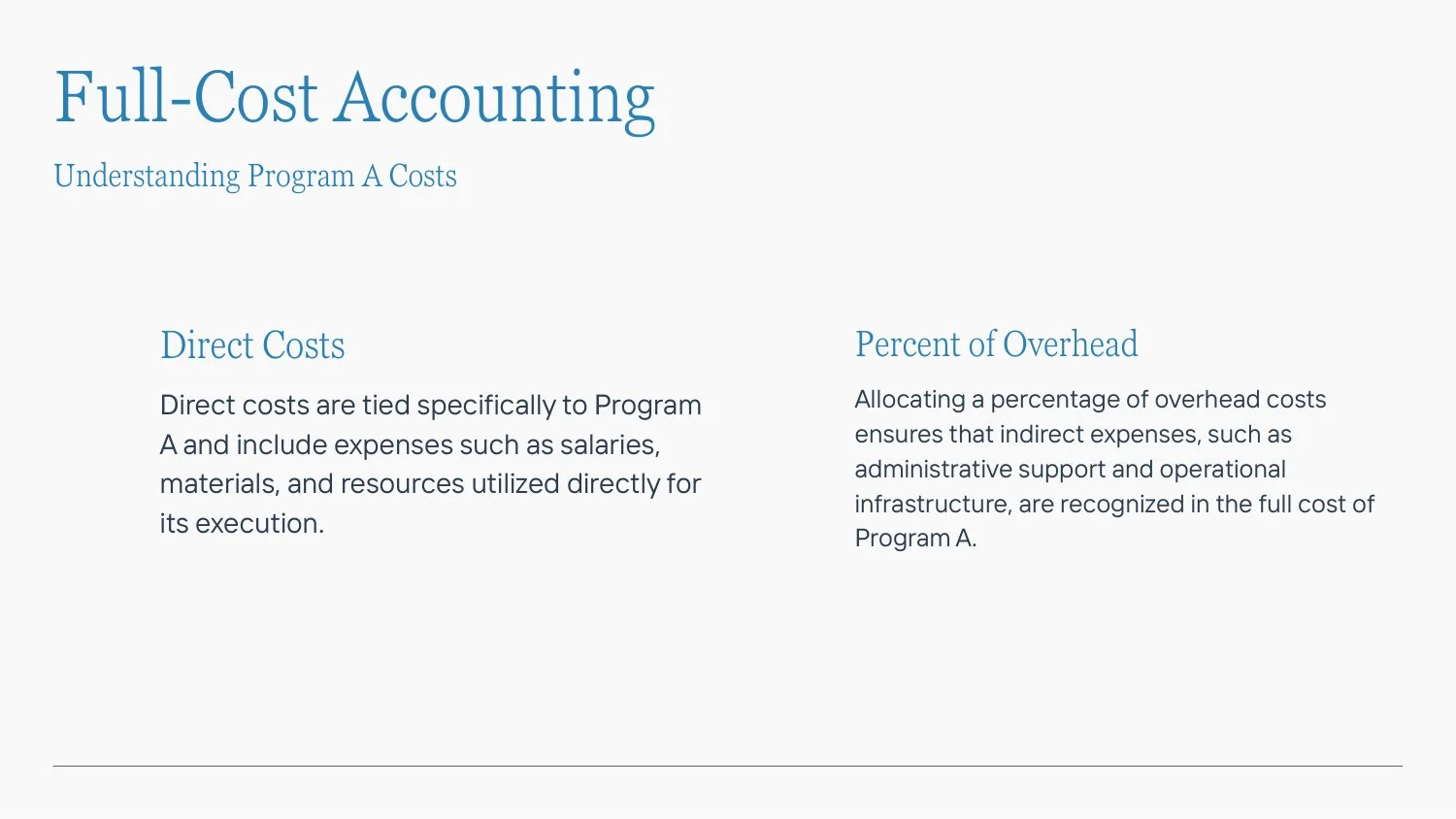
What full-cost accounting actually looks like
The practice of understanding your real operating costs is sometimes called full-cost accounting, and it requires doing a few things that many organizations skip.
First, you have to allocate overhead across programs proportionally. That means deciding on an allocation methodology, whether you are allocating based on staff time, square footage, direct costs, or some combination, and applying it consistently. Every program should carry its fair share of the organizational infrastructure that supports it. This makes your program costs look higher than they do in a grant budget, which feels uncomfortable, but it gives you an accurate picture of what each program actually costs to sustain.
Second, you have to build an operating budget that starts from total organizational costs, not from the sum of your program budgets. Those two approaches will produce different numbers, and the difference is information. If your program budgets add up to $3.2 million and your actual operating costs are $4.1 million, you have a $900,000 gap that is being covered somehow, whether by drawing down reserves, by relying on unrestricted contributions, or by simply not funding the infrastructure adequately. You need to know which.
Third, your leadership team and board need to be looking at this picture regularly, not just at audit time. The operating budget should be a live management tool, not an annual document that gets produced and filed.
The questions worth asking
If you are not sure where your organization stands on this, here are a few questions worth bringing to your next leadership or board conversation.
Does your board receive financial reports that reflect total organizational costs, or primarily program performance against grant budgets? If it is the latter, they may be making governance decisions without a complete financial picture.
When you pursue a new program or expand an existing one, do you model the full organizational cost of that growth, including the administrative and infrastructure load it adds, or just the direct program costs? If you are only modeling direct costs, you are likely underpricing your services and subsidizing your funders without knowing it.
Could your executive director explain, without pulling a report, what the organization costs to run on a monthly basis and how much of that is covered by unrestricted funding? If that number isn't readily known, it's probably not being managed as actively as it should be.
And the most direct version of the question: does your leadership team know the difference between your program budgets and your operating budget, and does your actual budget reflect that difference? If the answer to either part is no, that is the place to start.
The organizations I have watched navigate financial difficulty most successfully are not always the ones with the most funding. They are the ones whose leadership understands what they actually cost to run and makes decisions accordingly. That clarity doesn't come from better grant reporting. It comes from building and using a complete operating budget as an actual management tool, not just as a document that gets produced once a year and handed to the auditors.
If this is something your organization is working through, I am happy to talk about what building that kind of visibility actually looks like in practice. You can reach me at atisha.burks@anchorpointrising.com.