The One Number That Tells You More About Your Business's Financial Health Than Anything Else
When I sit down with a new client or potential client, there is one document I ask for before anything else. It’s not the budget, it’s not the most recent audit, and it’s not the income statement or the cash flow projections. I ask for the reserves report.
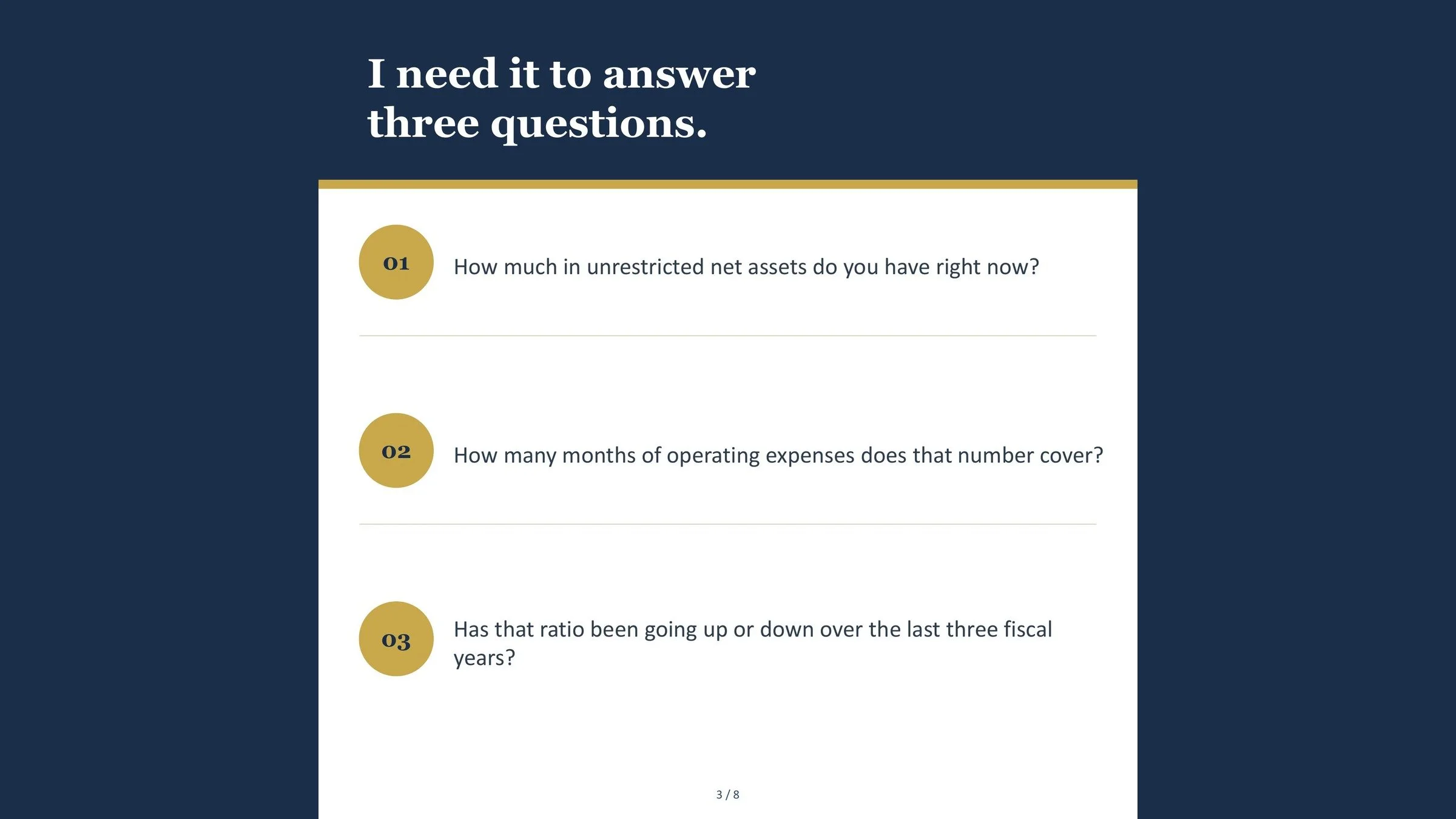
Specifically, I want to know three things: How much in liquid, unrestricted assets does the organization currently hold? How many months of operating expenses does that number cover, and has that ratio been trending up or down over the last three fiscal years.
That one sequence tells me almost everything I need to know before we go any deeper.
Most people are surprised by that. They expect me to start with the budget or the financials. But here is the thing, a budget only tells me what you planned. An audit only tells me whether the numbers were recorded correctly. However, the reserves ratio tells me whether the organization can absorb a hit and keep moving.
Why the budget and the audit are not enough
I am not dismissing either one. A clean audit matters, and a realistic budget matters. But neither one tells you what happens when something goes wrong.
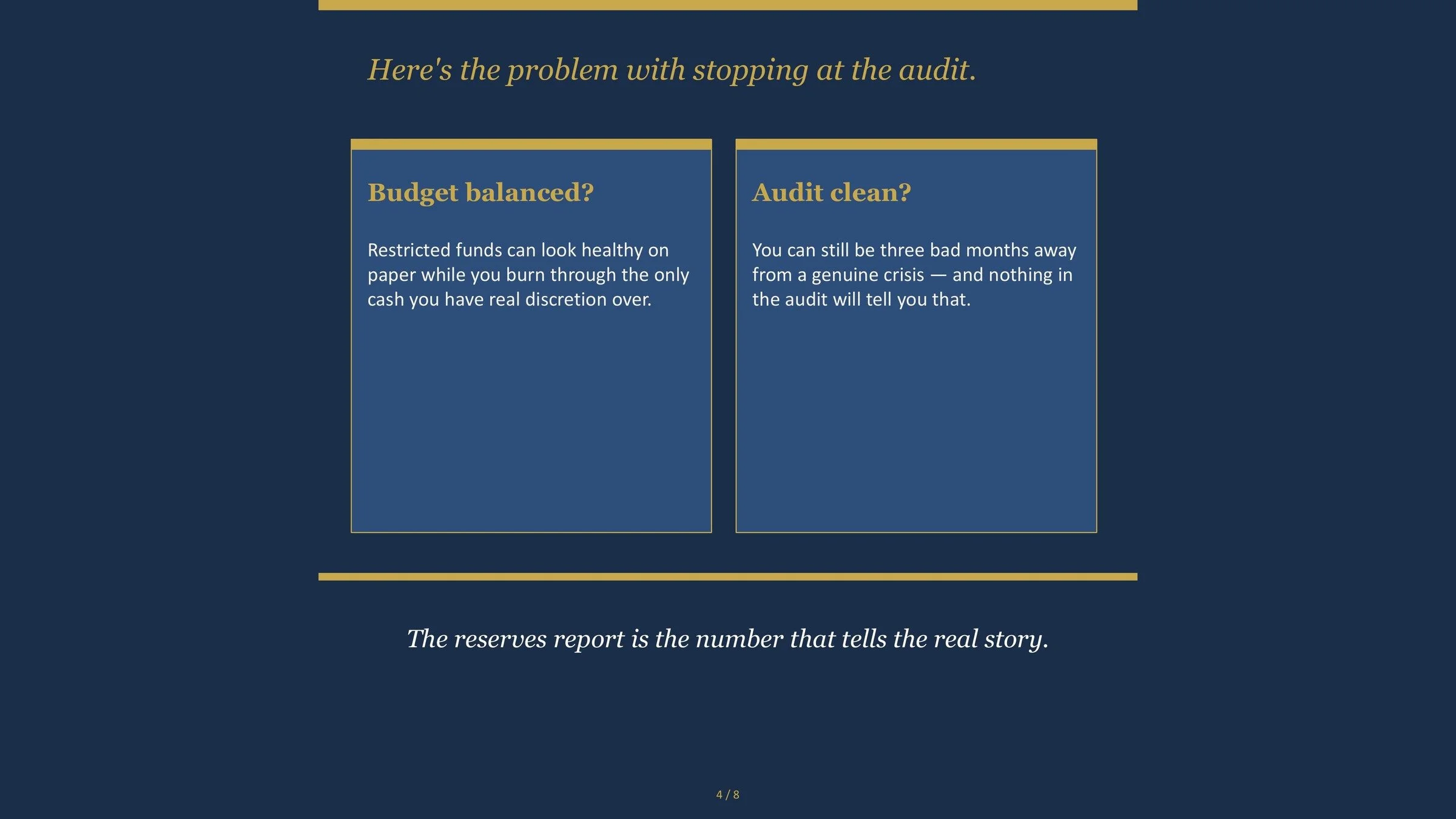
Here is the scenario: An organization looks fine on paper. The budget is balanced, revenue is coming in, the audit has no findings, and leadership feels reasonably good about where things stand. And then something shifts: a contract gets delayed, a key client pulls out, an unexpected expense hits, a grant cycle runs long. Now, all of a sudden, there is a gap, and there is nothing to bridge it.
The budget can be balanced. The audit can be clean. You can still be three bad months away from a genuine crisis.
That is what a low reserves ratio looks like in practice. It is not a dramatic collapse, but rather an organization that was always one disruption away from a problem, and nobody was tracking the number that would have shown them that.
What the reserves ratio actually measures
The reserves ratio is straightforward once you know what you are looking for.
Start with your liquid, unrestricted assets. These are funds you can access and spend without donor, board, or legal restrictions. It’s not your total net assets, your endowment, or the funds that are restricted to a specific program or purpose. The number you want is what you could actually deploy in an emergency.
Then divide that number by your average monthly operating expenses. The result tells you how many months you could sustain operations if your revenue stopped today.
Generally speaking:
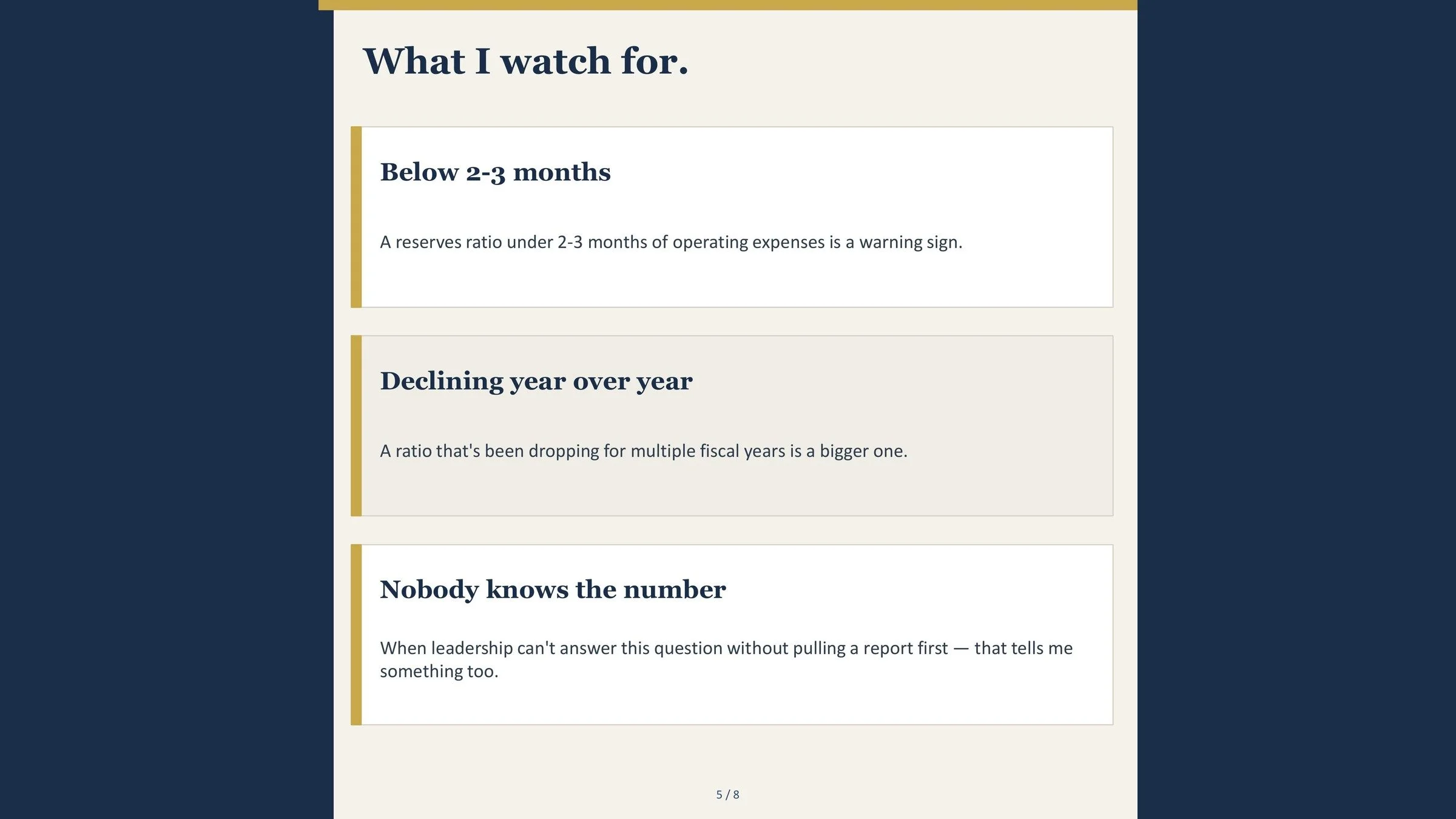
Less than 2 months: You are in fragile territory.
2 to 4 months: Adequate, but not much room for error.
6 months or more: You have real flexibility and room to be strategic.
Those benchmarks shift depending on the type of business, the predictability of revenue, and how exposed you are to any single funding source. A business with highly reliable, recurring revenue can operate with a thinner cushion than one whose income is unpredictable or lumpy. But the framework holds across industries.
The trend matters as much as the number
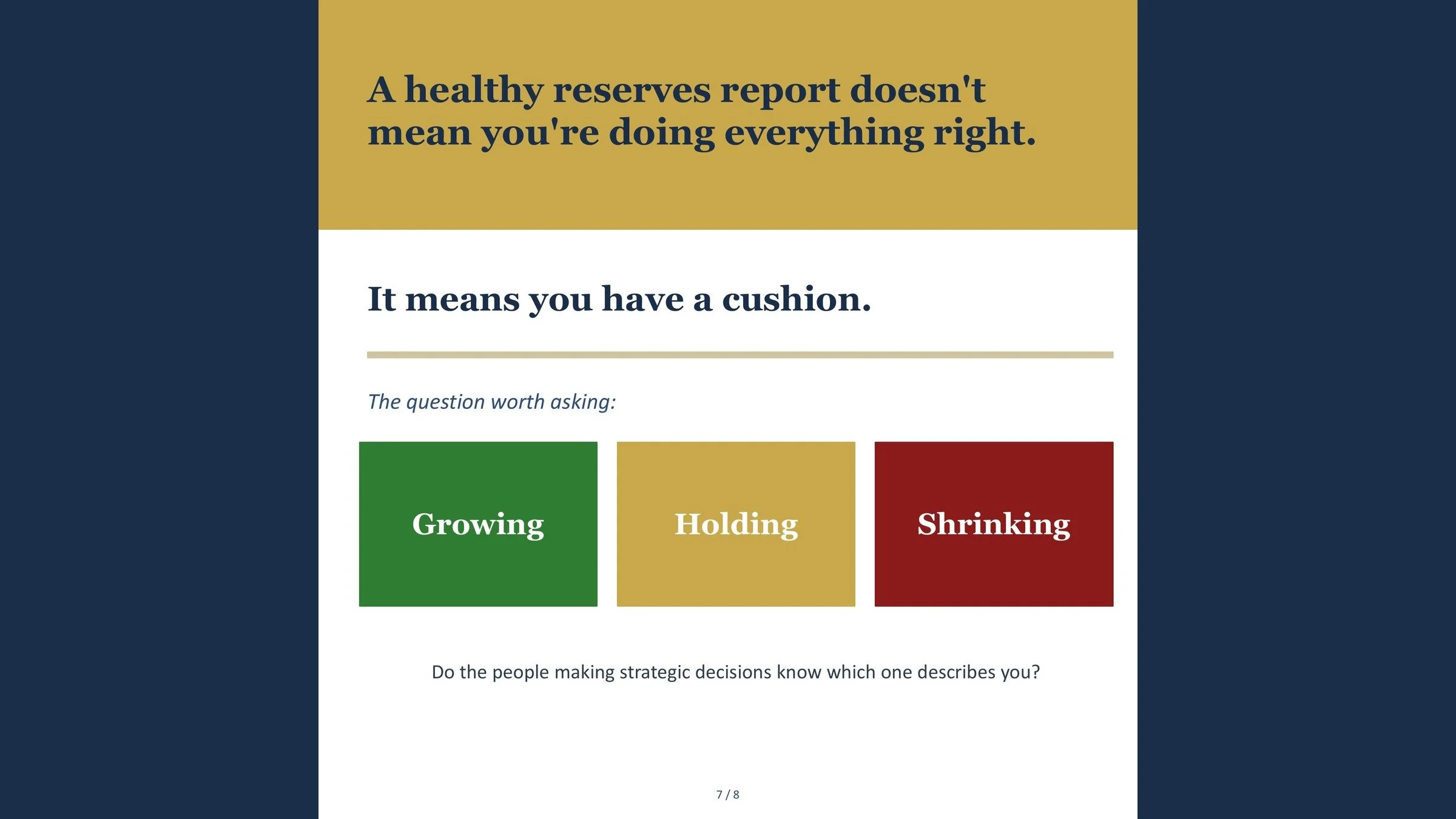
A single year's reserves ratio gives you a snapshot. What tells a deeper story is whether the ratio has been growing, holding steady, or shrinking over the last several fiscal years.
A declining ratio is almost always more concerning than a low one. If your reserves ratio has dropped from 4 months to 2.5 months to 1.8 months over three years, the current number is not your problem. The direction is your problem. Something structural is going on: expenses are outpacing revenue, margins are eroding, or the organization has been drawing down reserves without rebuilding them. Any of those is worth understanding before it goes further.
A single year's number gives you a snapshot. Three years of trend gives you a story.
On the other hand, an organization with a 2-month reserves ratio that has been climbing steadily is in a much better position than its absolute number suggests. Leadership is moving in the right direction. That context changes everything about how I approach the conversation.
The question that tells me more than the report
When I ask a leadership team what their current reserves ratio is, there are a few ways it can go.
Sometimes someone answers immediately. They know the number, they know the trend, and they can speak to why it has moved the way it has. That is a green flag. It tells me financial health is being actively monitored, not just reported at year-end.
More often, nobody answers right away. There is a pause, someone pulls up a file, and a few minutes later, they come back with a figure they are not entirely confident in. That is a yellow flag. The information exists, but it is not living in anyone's head. It is not part of the process by which decisions are made.
And occasionally, the number simply cannot be produced without significant digging. That is a red flag, not because something is necessarily wrong, but because it means financial health is being treated as a compliance exercise rather than a management tool.
How quickly an organization can answer that question tells me a lot about how financial information flows through the leadership structure.
Why most organizations I work with have fixable situations
I want to be direct about something. A low reserves ratio or a declining trend is not a verdict. It is a diagnosis.
In most cases, the situation is fixable. Organizations are not usually in crisis because of bad decisions or mismanagement. They are in a fragile position because nobody set up a system to track this specific number consistently, or because the urgency of day-to-day operations crowded out longer-term financial planning, or because the leadership team came up through programs or operations rather than finance, and never had someone help them build the financial muscle.
Those are solvable problems. A clear financial picture, a reserves policy with a realistic target, and a plan to rebuild the cushion over time can move an organization from fragile to stable faster than most people expect.
The organizations that stay fragile are usually the ones that do not realize where they are until something forces the issue.
What a healthy reserves picture actually looks like
Healthy does not mean perfect. It does not mean you have six months in the bank and nothing to worry about. It means you have a cushion, you know what it is, and the people making strategic decisions are watching it.
The organizations I have seen navigate disruption well tend to share a few things. They have a written reserves policy that defines a target range. They review the ratio at least quarterly, not just at year-end. They have a shared understanding at the leadership and board level of what the number means and what would trigger a conversation. And when the ratio dips, they treat it as information rather than a failure.
That kind of financial awareness does not require a large finance team. It requires someone who knows what to track and has built it into the rhythm of how the organization operates.
The place to start
If you read this and realized you do not know your current reserves ratio off the top of your head, that is actually a useful data point. It means there is a gap between the financial information your organization produces and the financial information your leadership team is actually using.
That gap is worth closing.
The calculation itself takes about ten minutes once you have the right numbers in front of you. What takes longer is building the habit of watching it, understanding what drives it in your specific context, and putting a plan in place if the number is not where it should be.
That is the work. And it is entirely doable.
Want to talk through what your reserves picture means for your organization? I offer a straightforward diagnostic conversation, no agenda, just the numbers and what they mean for where you are headed.