Fractional CFO and COO for Nonprofits and Associations
Strengthen financial stewardship, organizational visibility, and leadership accountability.

Nonprofits and associations must balance mission delivery with responsible stewardship. Leaders need to understand available resources, program economics, operating risks, cash requirements, funding restrictions, and the decisions that require board attention.
AnchorPoint Rising provides fractional financial and operational leadership to help nonprofit executives, boards, and finance committees create clearer reporting, stronger controls, and more disciplined decision-making.
Mission does not eliminate the need for financial and operational discipline.
Organizations can have committed teams, active programs, and engaged boards while still struggling to answer basic management questions:
Do we have the resources to carry out the plan? Which programs are financially sustainable? What portion of our cash is actually available? What should the board be watching? Who owns the response when performance begins to change?
APR helps translate financial and operational information into a practical leadership system that supports both mission and accountability.
What May Be Happening Inside Your Business
The board receives financial statements but not decision-ready information
Reports may show what happened without clearly explaining performance, liquidity, risks, emerging issues, or actions requiring board attention.
Restricted and unrestricted resources are difficult to interpret
Leadership may not have a clear, recurring view of which funds are available for general operations and which are committed to specific purposes.
Programs are active, but their full economics are unclear
Direct costs may be visible while staffing, shared services, administrative support, and long-term operating requirements are not consistently understood.
Governance and management responsibilities are blurred
Board members may become involved in operational details while management decisions, reporting expectations, or escalation responsibilities remain unclear.
What APR Can Help Strengthen
Board and finance committee reporting
Create concise reporting that highlights performance, liquidity, forecasts, risks, decisions, and recommended actions
Internal Controls
Strengthen approval, documentation, reconciliation, monitoring, access, and oversight practices without creating unnecessary bureaucracy.
Cash and Resource Visibility
Improve leadership’s understanding of available cash, restricted resources, near-term obligations, and future funding requirements.
Budgeting and Forecasting
Build a more useful connection between strategic priorities, program plans, expected funding, staffing, and operating costs.
Governance and Management Alignment
Define what management owns, what the board oversees, what committees should review, and when issues should be escalated.
Program and Grant Economics
Clarify the full cost of programs, funding gaps, indirect support requirements, and the operational impact of grant commitments.
Services That May Fit Your Business
Fractional CFO Leadership
Best when the executive director, CEO, board, or finance committee needs ongoing senior-level ownership of financial planning, reporting, controls, liquidity, risk, or financial decision support.
Organizational Assessment
Best when leadership needs an objective review of reporting, governance, workflows, accountability, controls, and organizational capacity before deciding what to change.
Executive Advisory
Best when an executive director, CEO, treasurer, board chair, or finance committee leader needs a confidential thought partner for a defined financial, operational, or governance issue.
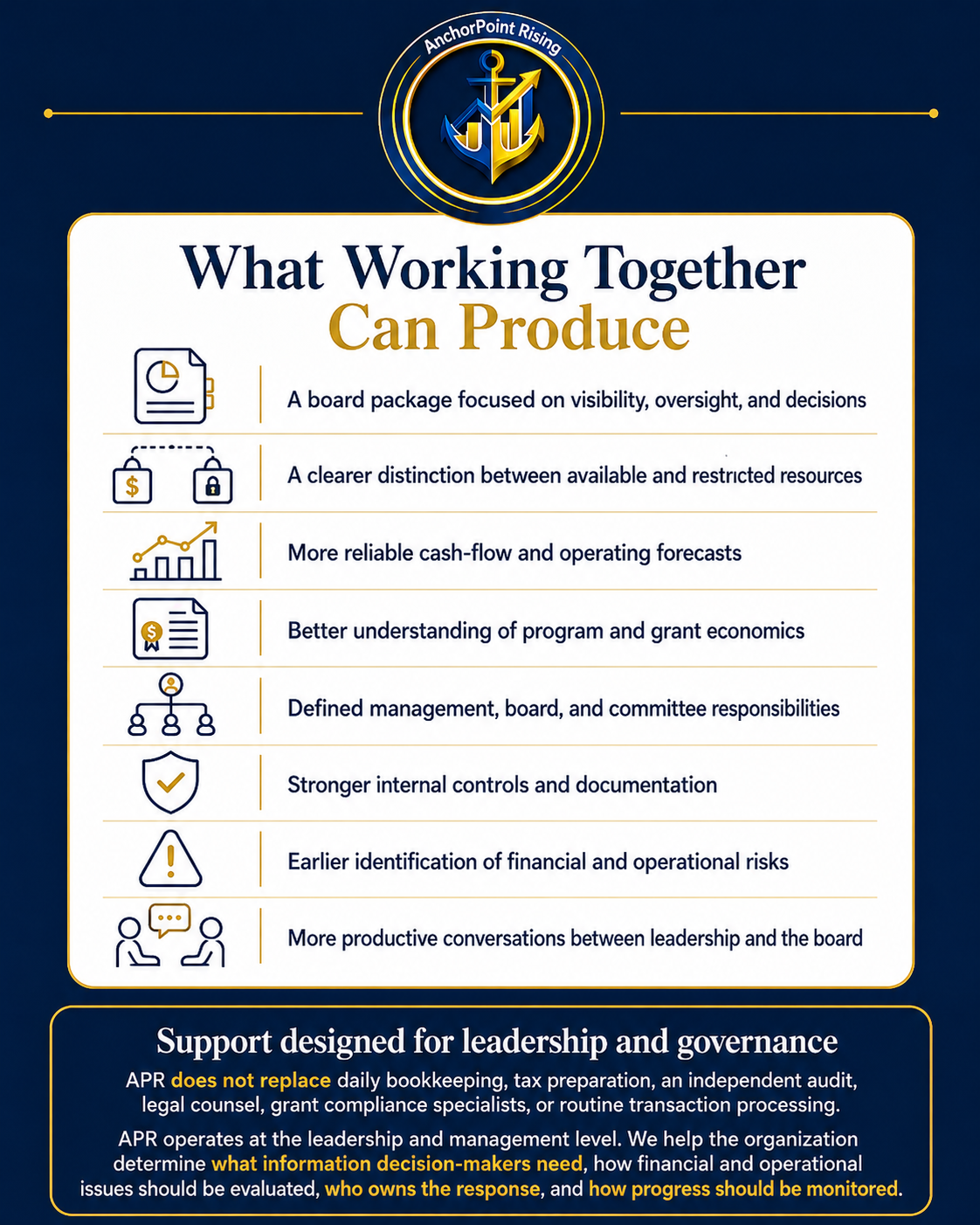
APR may be a strong fit when:
Your organization has multiple programs, funding sources, chapters, departments, or restricted resources
The board or finance committee needs clearer financial information
Leadership is preparing for growth, restructuring, transition, or increased oversight
Financial statements are available but are not translating into timely decisions
The organization needs stronger controls without adding unnecessary administrative burden
You need experienced financial leadership but do not require a full-time CFO
Is APR a good fit for your business?
Protect the mission by strengthening the system behind it.
Responsible stewardship requires more than accurate accounting. It requires leaders and boards to understand the organization’s financial position, operating capacity, risks, and choices.
APR helps build that visibility and discipline.
Frequently Asked Questions
-
A fractional CFO provides senior financial and operational leadership on a part-time or as-needed basis, without the cost of a full-time hire. For nonprofits and associations, that typically means board and finance committee reporting, cash and restricted-fund visibility, budgeting and forecasting, and internal controls, delivered by someone who has done this work before rather than learned it on the job.
-
Bookkeepers and accountants record and organize financial transactions. A fractional CFO uses that information to look forward, assessing risk, modeling funding scenarios, and advising the board or executive director on what a decision actually costs. Most nonprofits need both roles. Few need a full-time CFO.
-
Yes. Much of this work involves building reporting that boards and finance committees can actually use, and being available to walk through decisions or answer questions at meetings when needed.
-
Yes. Clarifying which funds are available for general operations and which are committed to specific programs or grants is one of the more common gaps we help close.
-
Not a specific size, but organizations tend to benefit most once they have multiple programs, funding sources, or chapters, or when financial statements exist but aren't translating into timely board decisions.
-
We support nonprofit boards and finance committees nationwide, with a strong presence in New Hampshire and Maine, including Portsmouth, Dover, Concord, and Berwick.
-
Costs vary based on the size of your organization and the scope of work involved. Across the industry, fractional CFO engagements typically run $175 to $450 per hour, or $1,750 to $10,000 or more per month for an ongoing retainer, depending on how much time and involvement your organization needs. We scope every engagement individually rather than using a flat rate, since a small nonprofit with one funding source needs a very different level of support than an association managing multiple chapters and grants.
-
This depends on your organization's size and complexity. Smaller or earlier-stage organizations often need as little as 8 to 10 hours a month, while larger or more complex nonprofits, especially those managing multiple programs, funding sources, or an upcoming audit, typically need more ongoing time. We set the scope based on what your board and finance committee actually need, not a fixed package.