Fractional Financial and Operational Leadership for Higher Education Institutions
Turn fragmented information and competing priorities into clearer institutional decisions.

Colleges and universities operate across academic, administrative, financial, enrollment, technology, research, and student-support functions. Each area may produce valuable information, but institutional leaders often lack a consistent structure for connecting it.
AnchorPoint Rising helps higher education leaders strengthen institutional reporting, financial and operational visibility, cross-functional accountability, data-informed decision-making, and the execution of major institutional priorities.
Institutional complexity requires more than another report.
A university may have extensive data and still struggle to answer the questions that matter most.
Are enrollment assumptions aligned with the financial plan? Do leaders agree on which numbers are authoritative? Can the institution see emerging risks early enough to respond? Are major priorities supported by clear ownership, milestones, and reporting? Did the last reorganization actually change how work gets done?
APR helps institutions connect strategy, financial information, operating activity, governance, and accountability.
What May Be Happening Across the Institution
Leadership receives multiple versions of the same information
Different offices may define, calculate, or report institutional measures differently, making it difficult to establish a shared view of performance.
Enrollment, staffing, and financial planning are not fully connected
Changes in enrollment or student mix may affect revenue, instructional requirements, student services, housing, staffing, and cash in ways that are not evaluated together.
Strategic initiatives lack consistent execution discipline
Institutional priorities may be approved without clear owners, dependencies, milestones, escalation rules, or a recurring leadership review.
Organizational changes have not changed the operating model
New offices, new grant and funding policies, new reporting relationships, or new leadership roles may have been established while workflows, decision rights, systems, and accountability remained largely unchanged.
How Fractional Staffing Works for Colleges and Universities
Institutional Reporting
Develop leadership and board reporting that connects financial condition, enrollment, operations, strategic priorities, risk, and decisions.
Data governance and decision consistency
Help establish ownership, definitions, decision rights, validation expectations, and escalation procedures for critical institutional information.
Strategic initiative execution
Translate priorities into accountable workstreams with owners, milestones, measures, dependencies, and leadership review routines.
Enrollment and Financial Alignment
Connect enrollment assumptions, revenue expectations, staffing, capacity, and operating requirements to support more informed planning.
Modernization and organizational change
Support changes to processes, systems, reporting, structure, and ways of working so implementation extends beyond the initial announcement.
Cross-functional operating discipline
Clarify responsibilities and handoffs across finance, academic affairs, enrollment, institutional research, information technology, and administrative functions.
Services That May Fit Your Business
Organizational Assessment
Best when institutional leaders need an objective review of reporting, governance, data practices, workflows, organizational alignment, or execution barriers.
Organizational Change
Best when the institution is restructuring, modernizing systems, redesigning processes, implementing new governance practices, or changing how functions work together.
Fractional Executive Leadership
Best when an institution needs temporary senior financial or operational capacity to stabilize a function, lead an initiative, support a transition, or establish a new operating discipline.
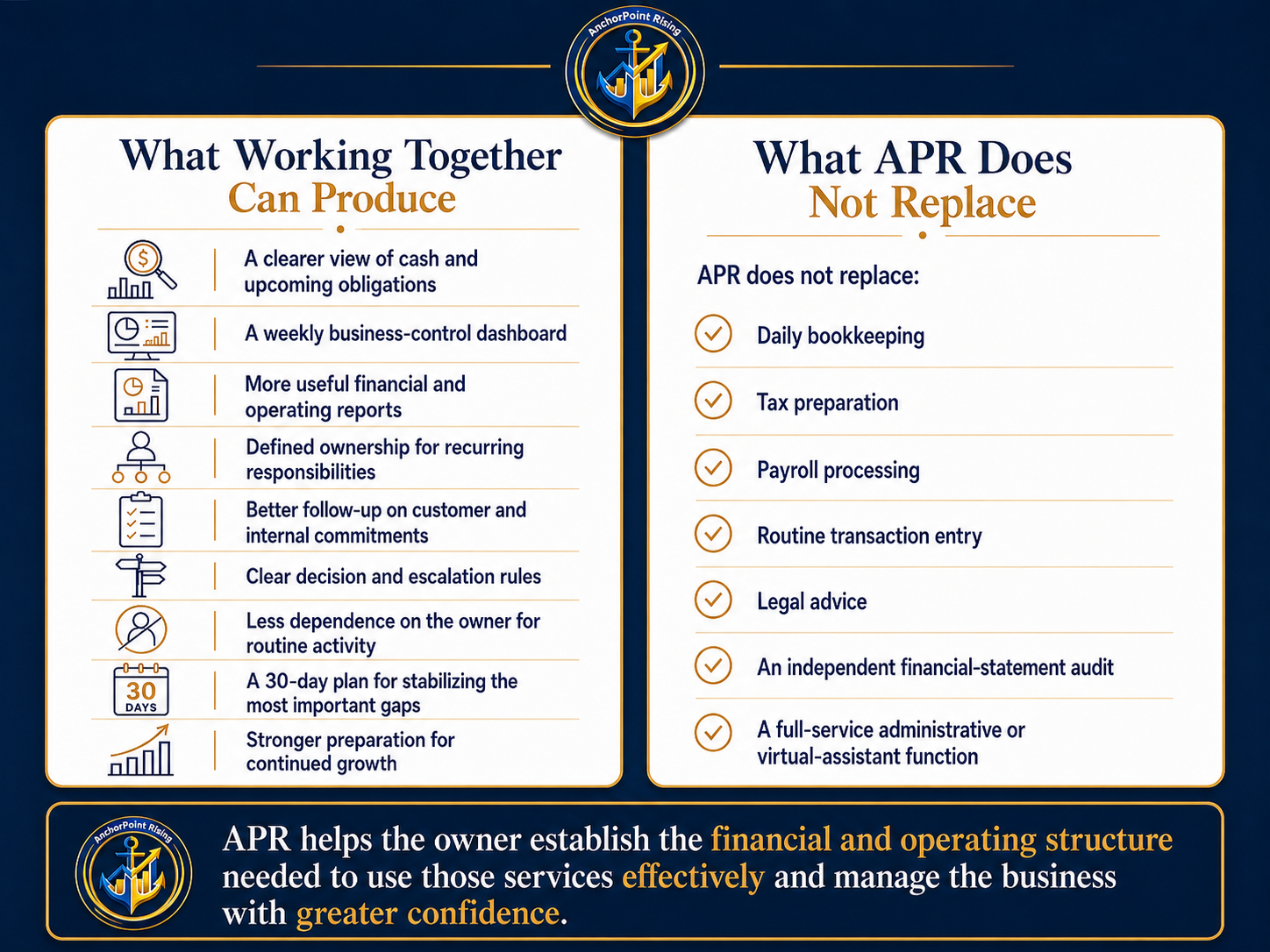
APR may be a strong fit when:
Senior leaders lack a shared view of institutional performance
Important data is fragmented across systems, offices, or spreadsheets
Enrollment, financial, and operational planning occur in separate processes
A major initiative needs stronger ownership and execution structure
The institution is navigating leadership transition, restructuring, or modernization
Leadership needs experienced capacity without immediately creating another permanent executive role